Basement Waterproofing Cape Cod: 4 Proven Layers
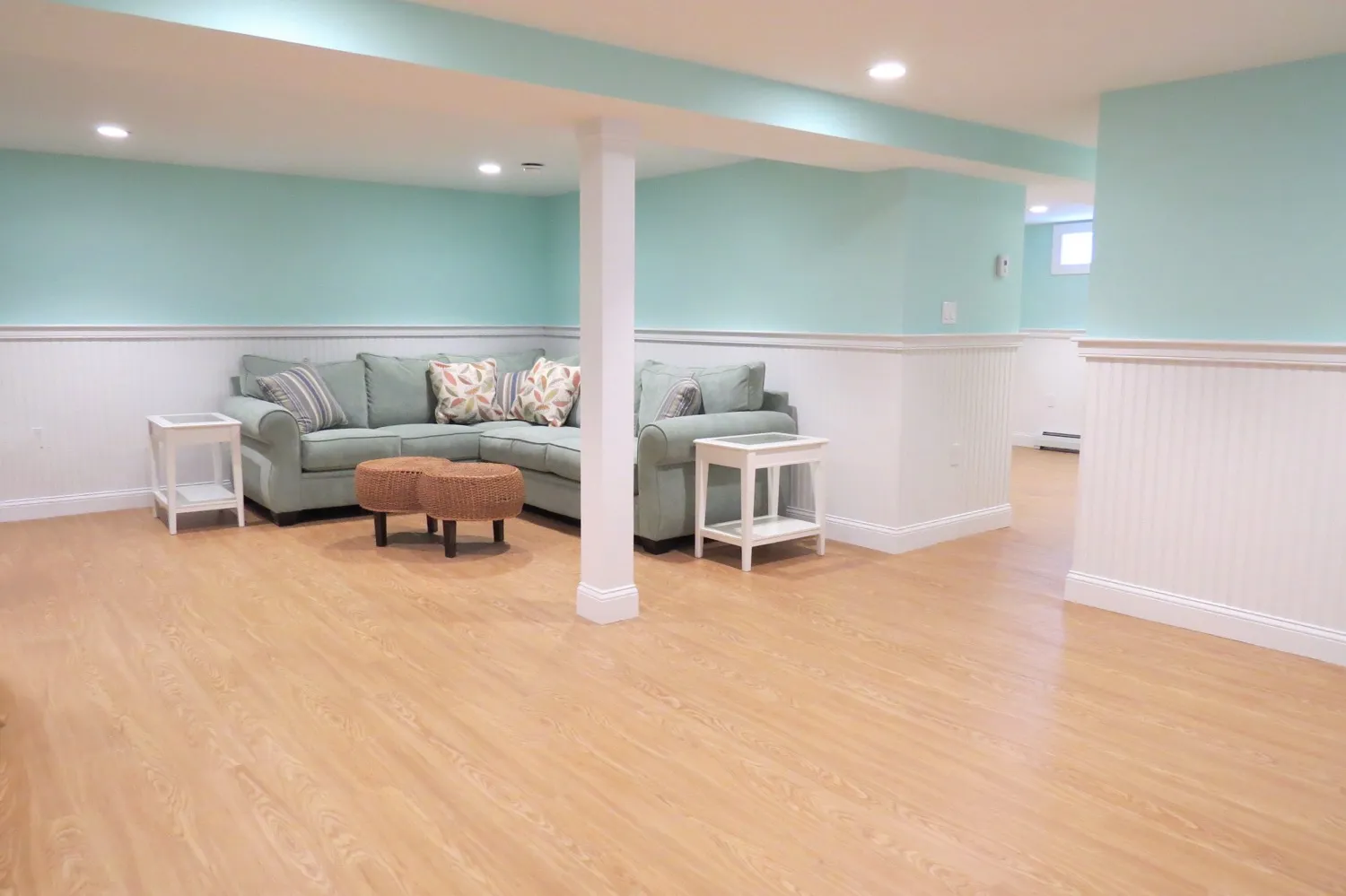
Basement waterproofing Cape Cod projects live or die on one decision: dealing with the water before you finish the space, not after. Most Cape Cod basements were never built to be finished living space — they were built as utility space below a house that sits on sandy soil with a water table close to the surface. Finish one of those basements without addressing the water first and you have made the most expensive mistake in Cape Cod remodeling: drywall, flooring, and trim go in, and within a year or two you are tearing it all back out.
This is the practical version of basement waterproofing Cape Cod homeowners actually need — how the water behaves here, the assessment that comes before any finishing plan, the four-layer system that keeps a finished basement dry, and how to tell when a basement simply isn’t worth finishing at all.
In this guide
- Why Cape Cod basements are different
- The pre-remodel water assessment
- The basement waterproofing Cape Cod strategy: 4 layers
- Materials that survive a Cape Cod basement
- When a basement isn’t worth finishing
- When to call a pro
Why Cape Cod basements are different
Cape Cod sits on glacial outwash — sandy, well-draining soil over a shallow groundwater table that shifts with the seasons. In most Cape locations the water table rises significantly in spring and after extended wet stretches, and plenty of basements have foundation walls sitting within a few feet of that table at its peak.
The good news is that the soil drains well, so standing water dissipates fast. The bad news is that high humidity, periodic seepage, and hydrostatic pressure against foundation walls are constant background conditions. A finished basement here has to be built assuming moisture will try to get in — not assuming you have sealed it out forever. That single mindset shift is the foundation of every successful basement waterproofing Cape Cod project, and it is what separates a basement that stays dry for decades from one that fails in its first wet spring.
The pre-remodel water assessment
Before any finishing plans, run a real water assessment. This is six to twelve months of observation, not a single afternoon’s inspection, because Cape groundwater is seasonal — a basement that looks bone-dry in August can weep steadily in March. Look for:
- Efflorescence on foundation walls — the white, powdery deposit that means moisture is wicking through the concrete
- Staining at the base of walls or at the cove joint where the floor meets the wall
- Active or historic seepage marks anywhere around the perimeter
- Sump pump history — how often it runs, when, and after what kind of weather
- Dehumidifier behavior — how much water it pulls in a normal week versus after heavy rain
- A musty smell, which signals persistent humidity even when there is no visible water
- A slab moisture test — tape a two-foot square of plastic to the floor for 48 hours; condensation underneath means vapor is moving up through the slab
If the assessment turns up any persistent water intrusion or hydrostatic pressure, that gets fixed before a single sheet of drywall goes up. Putting finishes over a wall that gets wet twice a year is throwing money away — and it is exactly the failure that makes basement waterproofing on Cape Cod feel like an impossible problem when it is really a sequencing problem.
The basement waterproofing Cape Cod strategy: 4 layers
A durable basement waterproofing Cape Cod strategy almost always combines four layers, working from the outside in:
- Exterior water management — gutters that actually carry water away from the foundation, downspout extensions, grade sloped away from the house, and French drains where the lot warrants them. This is the cheapest and most effective layer, and most basement water problems start as surface-water problems.
- Interior perimeter drainage — a channel drain at the cove joint that captures any wall or floor seepage and routes it to a sump pit. This is the workhorse system for finished Cape basements.
- A sump system with battery backup — a correctly sized pump, piped to daylight or to a dry well well away from the foundation, with a battery backup or generator-fed circuit. Power outages on the Cape tend to happen during exactly the storms that drive groundwater up, so backup isn’t optional.
- Vapor and humidity control — the layer that gets forgotten. A dehumidifier sized for the finished square footage, running on a dedicated drain instead of a tank you have to empty, keeps humidity below the point where mold can establish. Most builders keep finished basements at or below 50% relative humidity, comfortably inside the 30–60% range that EPA guidance on controlling indoor moisture and mold recommends.
Get these four layers right and the finishing work becomes ordinary carpentry. Skip one and every other dollar you spend on the basement is at risk.
Materials that survive a Cape Cod basement
The wrong materials in a damp basement turn into a teardown in five years. Every material choice in a basement waterproofing Cape Cod build should assume the slab and walls will occasionally get damp. Use:
- Inorganic insulation — closed-cell spray foam or rigid foam board against the wall, never fiberglass batts, which hold moisture
- Moisture-resistant drywall or cement board below grade
- Tile, luxury vinyl plank, or sealed concrete flooring instead of hardwood or carpet over a moisture-prone slab
- Pressure-treated bottom plates on any wall framing that touches the slab
- Mold-resistant paint on all painted surfaces
- Solid-core or moisture-rated interior doors instead of hollow-core
Skip wood subfloors over a slab unless you have installed a proper vapor barrier and dimpled membrane underneath. Skip baseboards that absorb moisture. Skip wall-to-wall carpet under any condition — it is the first thing to grow mold and the last thing you want to tear out.
When a basement isn’t worth finishing
Some Cape Cod basements should stay unfinished, and an honest builder will tell you so. The signs:
- Visible water during normal rain events — finishing won’t fix the root cause
- Foundation walls with active cracks or significant settling — structural issues come before cosmetic ones
- Less than 7 feet of headroom — building code requires a 7-foot minimum for habitable space in most situations
- Lot conditions you can’t change — no basement waterproofing Cape Cod system can beat a lot that sits at or near sea level, on the wrong side of a coastal bank, or with chronic groundwater no pump fully tames
- No realistic egress — a basement bedroom needs a code-compliant egress window, which usually means excavating a window well on the exterior side
For those basements, the smarter play is to keep the unfinished space dry and usable for storage and mechanicals rather than fight the lot with money.
When to call a pro
Homeowners can handle the assessment phase, gutter and grading improvements, and dehumidifier sizing themselves. Interior perimeter drains, sump upgrades, structural foundation work, and the finished build-out are where a contractor with Cape-specific experience earns the fee.
If you’re weighing a basement project, get the water assessment done first and only then talk to a builder about finishing. A good basement waterproofing Cape Cod contractor will refuse to finish a basement that hasn’t been properly dewatered — and that refusal is worth listening to.
Custom Crafted Homes has been building and remodeling Cape Cod houses for more than fifty years — second-generation builders, third-generation on Cape Cod, family-owned since 1974, serving all 15 Cape Cod towns. We handle basement remodeling projects across the full range of conditions, including the difficult-to-dewater basements where the work has to start with basement waterproofing before any finishing happens. Call (508) 619-7909 or email info@customcraftedcc.com and we’ll come walk your basement within a business day or two.
Custom Crafted Homes — 667 Main Street #3-30, Dennis, MA 02638 · (508) 619-7909 · info@customcraftedcc.com. MA Construction Supervisor License #CS-074943 · Home Improvement Contractor Registration #169552 · BBB Accredited.