
The Cape Cod Builder’s Guide to Blower Door Testing
If you're building a new home on Cape Cod — or doing a major renovation that triggers energy-code testing — at some point someone is going to say the words "blower door test," usually with the assumption that you already know what they mean. Most homeowners don't, and there's no reason they should. So here is the builder's version: what the test is, how Massachusetts energy codes use it, what the number actually means, and why air-tightness matters more on this stretch of coast than almost anywhere else in the state.

What a blower door test actually is
A blower door is a calibrated fan that temporarily replaces your front door. The rater seals it into the opening, turns it on, and pulls air out of the house until the inside is at a set pressure lower than outside — the standard is 50 pascals, which is roughly the pressure of a 20-mph wind hitting every side of the house at once.
With the house held at that pressure, the fan has to keep moving exactly as much air as the house is leaking. Measure how hard the fan is working and you've measured the leaks. You can't see air, but you can absolutely measure it — and once the fan is running, you can walk the house with a smoke pencil or an infrared camera and find precisely where the leaks are: the rim joist, the attic hatch, recessed lights, the gap behind the bathtub, the bottom plate of an exterior wall.
That's the whole idea. It turns "this house feels drafty" into a number and a map.
Why you're suddenly hearing about it: Massachusetts code
Massachusetts has three residential energy-code tracks: the statewide Base code, the opt-in Stretch code, and the opt-in Specialized code. Cape towns do not all use the same track, and local adoption dates change. All three current tracks build from the 2021 International Energy Conservation Code framework, which uses measured air leakage for new low-rise residential construction. Stretch and Specialized projects also use performance documentation such as a HERS rating (the energy score on the house), which includes the blower door result.
In plain terms: a blower door test is now a normal part of taking a new Cape Cod house through energy-code signoff. Your energy rater and town building department confirm the exact requirements for the municipality, permit date, project type, and compliance path. This is part of the build now, not just a green upgrade.
Why air-tightness matters more on Cape Cod
Here's the part the code language leaves out. A leaky house inland is mostly an energy-bill problem. A leaky house on the Cape is a moisture problem, and moisture is what actually destroys buildings here.
Think about what this house lives in: salt air, wind-driven rain off the water, long humid stretches in summer, and — for a lot of homes — months of being closed up and unoccupied. Every gap that lets air move through a wall also lets water vapor ride along with it. When that warm, wet air hits a cold surface inside the assembly, it condenses. Do that for a few seasons inside a wall nobody opens and you get the thing every Cape builder has cut into: damp sheathing, rusted fasteners, and rot in framing that looked perfect from the outside.
So when we chase air-tightness, we're not just chasing a lower oil bill. We're keeping water vapor out of the places it does the most expensive damage. On the coast, a tight, well-sealed, properly ventilated house isn't a luxury build — it's the one that's still sound in twenty years.
What the blower door test number means
Blower door results usually get reported as ACH50 — air changes per hour at 50 pascals — which is just "how many times per hour the entire volume of air in the house leaks out and gets replaced, under test pressure." Lower is tighter.
- An older, untouched Cape can test many times leakier than current new construction — that's a house breathing through every seam.
- New low-rise residential construction under the current Massachusetts code framework generally has to test at 3 ACH50 or below, depending on the building type and compliance path.
- A high-performance build may push toward 1.0 ACH50 or lower. Certified Passive House projects use an even stricter airtightness standard and a different level of detailing entirely.
You don't need to memorize the numbers. The point is that the result is a real, third-party measurement of how well the house was actually built — not how it was drawn.
The builder's view: passing the blower door test starts long before test day
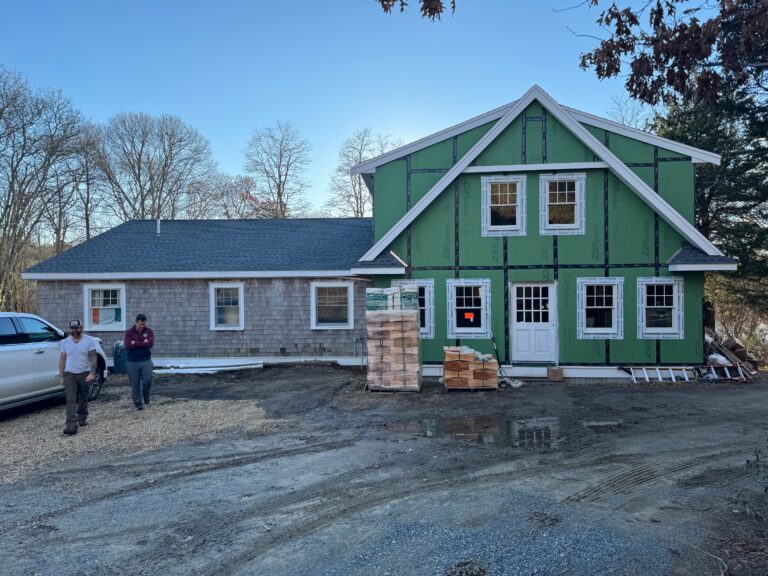
This is where it matters who's holding the tools. You cannot air-seal a house at the end. Tightness is the sum of a hundred small decisions made while the house is open — how the rim joist is sealed, how the bottom plates are gasketed, how every window and door is flashed and foamed, how the ceiling plane is detailed before insulation, how every wire, pipe, and duct penetration is treated. By the time a blower door shows up, those decisions are already inside the walls.
That's why, when we frame and finish our own custom homes, air sealing is part of the framing standard, not a separate "energy" line item handed to a sub at the end. The crew that's accountable for the build is accountable for the number. The same goes for a major general contracting renovation or a home addition — anywhere you open a wall is a chance to seal it right, and a chance, if it's done carelessly, to create a moisture trap that didn't exist before.
There's also a real ventilation half to this. A tight house has to breathe on purpose — mechanical fresh-air ventilation, good bath and kitchen exhaust, moisture control — so you're not just sealing problems inside. Tight without ventilation is its own mistake. Doing both correctly is what "high-performance" actually means.
When a blower door test shows up in your project
You'll run into one in four situations:
- New construction — required for energy-code signoff; your rater confirms the applicable compliance path and HERS requirements.
- A gut renovation big enough to trigger the energy code on the affected areas.
- An addition, where the new construction has to meet current standards and the connection to the old house needs careful sealing.
- An existing house you just want to fix — here a blower door is the diagnostic tool, run as part of an energy audit to find exactly where your comfort and your bills are leaking out, before you spend a dollar on insulation.
That last one is worth knowing about even if you're not building. If a room is always cold, a bill is always high, or a corner is always damp, the blower door is how a builder finds the cause instead of guessing.
For the common timing, cost, and process questions that come up around this, the FAQ is a good starting point — then we confirm the specifics for your house with a visit.
How we approach the blower door test
We build for the place we live in. Across all 15 Cape Cod towns and their 50+ villages — from Barnstable to the Outer Cape — that means treating air sealing and moisture control as core construction quality, not an upsell, and building to pass the test on the first try rather than chasing leaks after the drywall is up. We're family-owned since 1974, second-generation builders, third-generation Cape Cod, fully licensed (MA CS-074943, HIC #169552) and BBB-accredited.
If you're planning a new home, a renovation, or an addition and you want it built tight, dry, and comfortable for the long haul — or you just want to know why your current house never feels right — tell us what you're working with. We'll respond within one business day and set up a time to look at it. Call (508) 619-7909 or send us a message.